

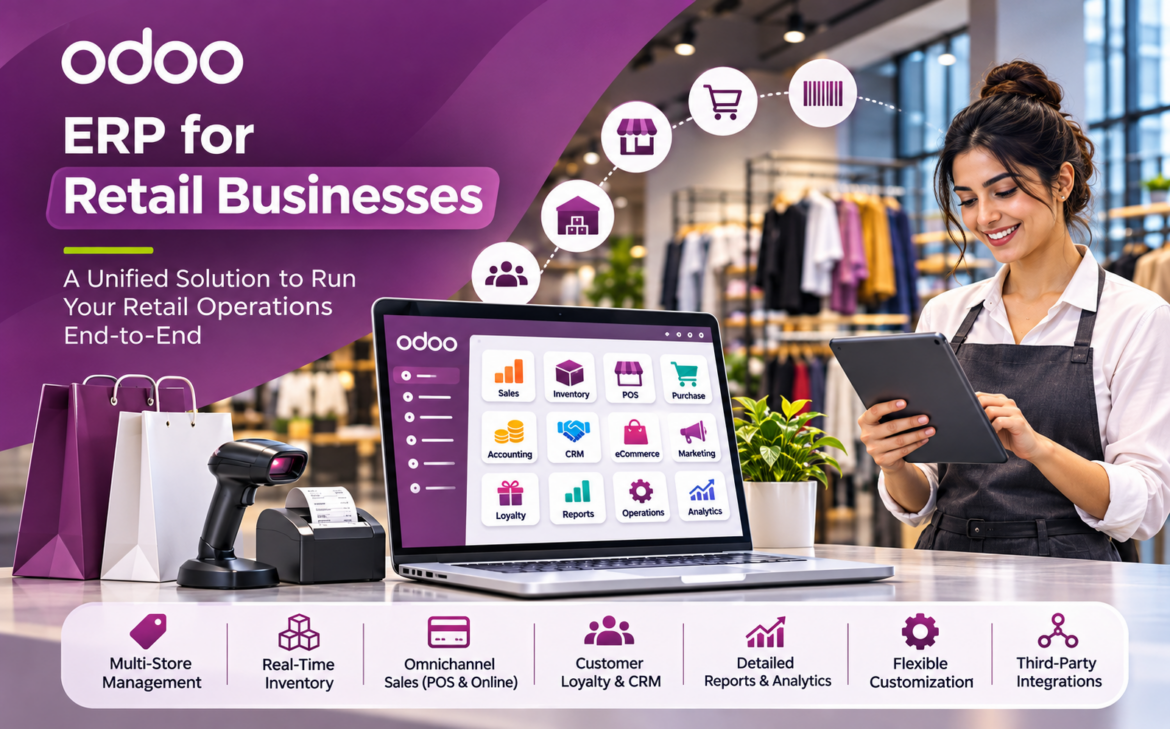
How Xibtech Solutions helps retail businesses connect sales, inventory, finance, eCommerce, warehouses and customer operations through tailored Odoo ERP solutions.
Retail businesses today operate in an increasingly complex environment. Managing multiple stores, warehouses, online marketplaces, customer orders, supplier relationships, financial transactions and real-time inventory requires more than disconnected software applications.
As retail businesses expand across locations, sales channels and markets, operational complexity grows. Manual processes, disconnected systems and limited visibility can create inventory inaccuracies, delayed order fulfilment, financial discrepancies and inconsistent customer experiences.
This is where Odoo ERP implementation, retail system integration and business-specific customisation can make a significant difference.
At Xibtech Solutions, we help retail businesses implement and customise Odoo ERP to manage interconnected operations, integrate third-party platforms and automate 100+ complex business workflows within a unified technology ecosystem.
Our approach goes beyond standard ERP configuration. We focus on understanding the operational challenges of each retail business and designing solutions that support its unique processes, integrations and growth requirements.
Why Retail Businesses Need a Customised Odoo ERP Solution
No two retail businesses operate in exactly the same way.
A supermarket chain managing thousands of SKUs has different operational requirements from a fashion retailer handling seasonal collections, a jewellery business tracking serialised products or an electronics retailer managing warranties and after-sales services.
While standard ERP modules provide a strong foundation, growing retailers often require additional configuration, customisation and integration to support their business models.
Common retail challenges include:
– Managing inventory across multiple stores, warehouses and online channels.
– Synchronising POS transactions with centralised accounting and stock records.
– Handling complex pricing, discounts, promotions and loyalty programmes.
– Managing supplier purchasing, replenishment and approval workflows.
– Integrating eCommerce websites, marketplaces and payment gateways.
– Processing returns, exchanges, refunds and warranty claims.
– Consolidating financial reporting across branches and legal entities.
– Tracking product variants, serial numbers, batches and expiry dates.
– Automating inter-branch stock transfers and warehouse fulfilment.
– Maintaining consistent customer information across multiple sales channels.
A properly designed Odoo ERP solution connects these operations while allowing businesses to maintain the flexibility required by their industry.
One Odoo ERP Platform, Multiple Retail Business Models
Xibtech Solutions provides Odoo implementation and customisation services for diverse retail industries.
| Retail industry | Specialised Odoo workflows |
|---|---|
| Supermarkets & Grocery | POS, expiry tracking, replenishment, promotions, supplier management |
| Fashion & Apparel | Size and colour variants, seasonal inventory, returns, omnichannel sales |
| Electronics & Appliances | Serial number tracking, warranties, repairs, after-sales support |
| Jewellery & Luxury Retail | Product traceability, custom pricing, approvals, high-value inventory |
| Furniture & Home Décor | Showroom sales, delivery scheduling, installation, supplier orders |
| Automotive Parts | Product compatibility, spare-parts inventory, supplier procurement |
| Pharmacy & Healthcare Retail | Batch tracking, expiry management, regulated product workflows |
| Cosmetics & Beauty | Product variants, promotional bundles, loyalty programmes |
| Building Materials & Hardware | Bulk pricing, B2B quotations, warehouse transfers, credit sales |
| Multi-brand Retail Chains | Centralised procurement, branch inventory, consolidated reporting |
Each retail segment requires its own operational logic. Rather than forcing businesses to change every process to match standard software, Xibtech evaluates where Odoo configuration, extensions or custom development can provide the best fit.
Managing 100+ Complex Retail Workflows with Odoo
Large and growing retail businesses can have hundreds of interconnected operational processes.
These workflows may involve different departments, approval hierarchies, systems, store locations and customer touchpoints.
At Xibtech Solutions, we design Odoo solutions capable of supporting 100+ interconnected retail workflows, depending on business requirements, operational complexity and the selected Odoo edition.
1. Sales and Point of Sale (POS) Automation
Connect retail counters, branches and sales teams through integrated POS operations.
Typical workflows include multi-store POS management, customer-specific pricing, discount approvals, gift cards, loyalty programmes, exchanges, refunds, cashier controls and sales reconciliation.
2. Inventory and Warehouse Management
Maintain visibility across warehouses, retail outlets and distribution centres.
Automate stock replenishment, internal transfers, barcode scanning, inventory adjustments, product traceability, stock reservations and fulfilment processes.
3. Procurement and Supplier Management
Improve purchasing operations through automated purchase requests, supplier comparisons, approval matrices, vendor price lists, purchase orders, goods receipts and invoice matching.
4. Finance and Accounting Integration
Connect operational transactions with financial processes, including customer invoicing, supplier bills, tax configuration, payment reconciliation, branch-level profitability and consolidated reporting.
5. eCommerce and Omnichannel Retail
Connect physical stores with digital sales channels to support online orders, inventory synchronisation, customer records, payment processing, order fulfilment and returns.
6. Customer Relationship Management and Loyalty
Build more connected customer experiences through customer segmentation, purchase histories, loyalty rules, promotional campaigns, customer support and targeted marketing workflows.
7. Delivery, Logistics and Fulfilment
Support delivery assignments, picking and packing, shipment tracking, courier integrations, proof of delivery and return logistics.
8. Management Reporting and Operational Controls
Provide business leaders with dashboards covering sales performance, inventory movement, procurement efficiency, margins, branch performance and operational exceptions.
These workflow categories can be expanded into more than 100 individual processes and automation rules based on each retailer’s operational requirements.
Advanced Odoo Integration with Third-Party Retail Systems
A successful retail ERP implementation should work with the existing technology ecosystem, not create another isolated application.
Xibtech Solutions designs integrations between Odoo and external business platforms through available APIs, connectors, middleware and custom integration services.
Common Retail Integration Requirements
| Integration category | Example platforms and systems |
|---|---|
| eCommerce | Shopify, WooCommerce, Magento / Adobe Commerce |
| Online Marketplaces | Amazon, Noon and other regional marketplaces |
| Payment Gateways | Stripe, PayTabs, Telr and supported payment providers |
| Shipping & Logistics | DHL, Aramex, courier platforms and delivery management systems |
| Business Intelligence | Microsoft Power BI, Tableau and reporting platforms |
| CRM | Salesforce, Microsoft Dynamics 365 and external CRM platforms |
| Marketing | WhatsApp Business Platform, email marketing and campaign tools |
| Finance & Banking | Banking interfaces, payment reconciliation and financial applications |
| Warehouse Technology | Barcode scanners, label printers, RFID and compatible warehouse devices |
| Enterprise Systems | External ERP applications, supplier portals and custom enterprise software |
Integration availability depends on platform APIs, licensing, regional support and technical compatibility. Where standard connectors do not meet business requirements, custom interfaces can be developed.
The objective is to create a connected retail ecosystem where information moves reliably between systems with minimal manual intervention.
Custom Odoo Development for Complex Retail Operations
Standard ERP functionality may not fully address specialised retail processes.
Xibtech Solutions provides Odoo customisation and development services to accommodate advanced business requirements while maintaining a structured, maintainable architecture.
Examples include:
Custom Pricing Engines: Dynamic pricing based on customer segments, purchase quantities, store locations, promotions, membership tiers and contract conditions.
Multi-Level Approval Workflows: Approval hierarchies for discounts, procurement, refunds, stock adjustments, credit limits and exceptional transactions.
Advanced Inventory Allocation: Custom allocation rules based on warehouse availability, order priority, store demand and fulfilment location.
Retail Franchise Management: Centralised reporting, franchise-specific permissions, inventory coordination and configurable financial controls.
B2B and B2C Sales Operations: Support wholesale customers, retail consumers, credit terms, bulk ordering, quotations and customer-specific commercial agreements.
Customer and Supplier Portals: Custom portals for order visibility, document exchange, service requests, approvals and transaction tracking.
Specialised Reporting: Industry-specific dashboards, management reports, operational KPIs and exception monitoring.
Custom POS Extensions: Retail-specific cashier workflows, additional validation rules, specialised receipts and integration with supported hardware.
Every customisation should be assessed against standard Odoo capabilities first to minimise unnecessary development and reduce future maintenance and upgrade complexity.
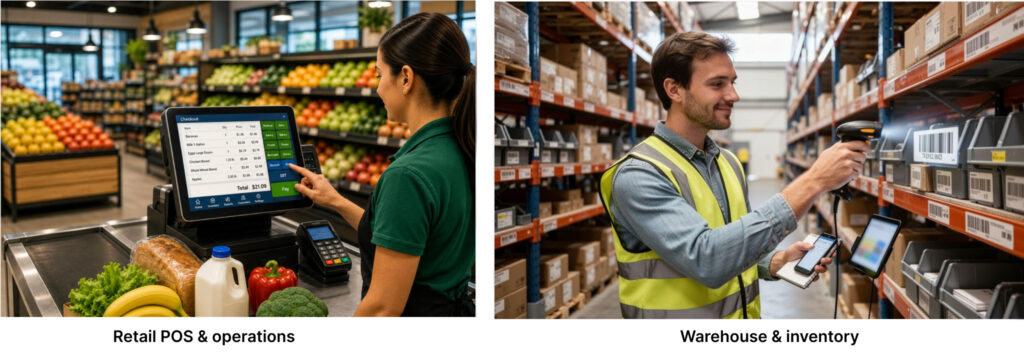
Odoo ERP for Multi-Store and Multi-Company Retail Businesses
Retail expansion introduces additional challenges, particularly when businesses operate multiple branches, warehouses, brands or legal entities.
With a properly configured Odoo architecture, businesses can support:
– Centralised inventory visibility across multiple locations.
– Branch-level sales, expense and profitability reporting.
– Intercompany transactions and stock transfers.
– Shared or separate product catalogues and pricing structures.
– Role-based access for store managers, finance teams and executives.
– Centralised procurement with local store fulfilment.
– Multi-currency operations and appropriate tax configurations.
– Consolidated management reporting across business units.
These capabilities can help retailers maintain operational consistency while preserving the controls needed by individual branches or entities.
Intelligent Retail Automation with Odoo and AI
Retail ERP solutions can be extended with intelligent automation to reduce repetitive activities and improve operational decision-making.
Xibtech Solutions can design AI-assisted and rules-based workflows using Odoo, custom integrations and automation platforms such as n8n.
Potential use cases include demand forecasting, low-stock notifications, supplier follow-ups, sales exception alerts, customer service assistance, document processing and management reporting.
For example, a retailer could configure an automated workflow that identifies products approaching reorder thresholds, checks approved suppliers, prepares purchase requests and routes them to the appropriate manager for approval.
AI-driven capabilities require appropriate data quality, technical integration, security controls and validation before production deployment.
Our Odoo ERP Implementation Approach
At Xibtech Solutions, we believe successful ERP implementation starts with understanding the business rather than simply installing software.
Our implementation methodology focuses on six key stages.
Stage 1 — Business Discovery and Workflow Assessment
We analyse existing retail operations, business challenges, departmental dependencies, integrations and reporting requirements.
Stage 2 — Solution Architecture and Process Mapping
We define the Odoo module architecture, map business workflows, identify integration requirements and determine where custom development is necessary.
Stage 3 — Configuration and Customisation
Our implementation team configures relevant Odoo modules, develops approved custom workflows and establishes user permissions and operational controls.
Stage 4 — Third-Party Integration and Data Migration
We connect supported external systems, prepare master data, migrate agreed historical records and validate data integrity.
Stage 5 — Testing, Training and Go-Live
We perform functional testing, integration testing, user acceptance testing and operational readiness checks before production deployment.
Stage 6 — Post-Implementation Support and Optimisation
After go-live, we provide agreed support, issue resolution, performance monitoring and continuous improvement services.
This structured approach helps reduce implementation risks and supports long-term system maintainability.
Business Benefits of a Well-Implemented Retail ERP
When supported by accurate data, well-designed processes and effective user adoption, an integrated Odoo solution can help retailers achieve meaningful operational improvements.
Potential benefits include:
– Improved inventory accuracy: Better visibility into stock movements, availability and replenishment.
– Reduced manual effort: Fewer duplicate entries and repetitive administrative tasks.
– Faster order processing: More coordinated sales, warehouse and fulfilment activities.
– Stronger financial visibility: Better reconciliation and consolidated operational reporting.
– Improved customer experience: More consistent customer information, order updates and service processes.
– Better management decisions: Access to more timely operational and financial information.
– Scalable operations: A configurable foundation for additional stores, sales channels and business processes.
Actual results depend on implementation scope, process maturity, data quality, training and adoption.
Why Choose Xibtech Solutions for Odoo Retail ERP Implementation?
Xibtech Solutions is an Odoo partner providing ERP implementation, integration, custom software development and business process automation services.
Our capabilities extend beyond configuring individual ERP modules. We help organisations design connected business systems that support complex operational requirements.
Our services include Odoo ERP consulting, implementation, custom module development, third-party API integration, data migration, workflow automation, user training and ongoing technical support.
We support retail businesses seeking to modernise existing operations, replace disconnected applications, integrate digital sales channels or develop specialised business workflows.
Whether you operate a single growing retail business, a multi-store retail chain, a wholesale distribution network or an omnichannel retail organisation, our approach focuses on aligning technology with your business objectives.
Planning an Odoo ERP Implementation for Your Retail Business?
Managing multiple stores, disconnected applications and 100+ complex workflows does not have to mean operating multiple isolated systems.
With the right Odoo ERP architecture, retail businesses can connect departments, automate operational processes and establish a more scalable foundation for growth.
Xibtech Solutions can help you evaluate, implement, integrate and customise Odoo ERP around your retail business requirements.
Let’s Build a Smarter Retail Operation
Looking to implement Odoo ERP, integrate your existing retail applications or automate complex business workflows?
Contact Xibtech Solutions to discuss your retail ERP requirements and explore a tailored implementation approach.


Leave feedback about this